I was surprised to find this morning, as I Googled "Igawa" at my desk, that the Yankees had put up $26 million dollars for the winning bid on the #2 Japanese arm on the market this offseason. At first, I thought it was too much money, and really I still do, but I think there are some logical reasons to like this move. Many Yankee fans around the blogosphere are complaining, while others are taking a wait and see approach. I'll give you my two cents on this player, from my firsthand observation of his pitching.
First, the bio on Igawa. I am going to steal the blurb written by Gary Garland over at
Japanese Baseball Daily, as it is comprehensive and also comes from significant firsthand experience. (Scroll down to "Igawa" for the full listing.) Gary is a master of everything related to Japanese baseball, and you should make his site a regular visit for interesting and informative perspectives on the game over here. Sorry for the piracy, Gary.
"Biography: Started playing nanshiki ball in third grade. Reportedly joined his junior high baseball team because they didn't have a soccer program. Is still a big soccer fan today. Had an 18 strikeout perfect game (it was called after seven innings) in high school and at one point struckout 72 over the course of 42 innings and was unscored upon in 35 straight frames. Was scouted by the Mets as a schoolboy. Had some back problems summer of his senior year and didn't pitch during that time. Drafted on the second round (1997). Had control problems his first year of pro ball and set a Western League record for wild pitches in a game with four. However, as Hanshin was going down the tubes again with a crap pitching staff, then manager Katsuya Nomura asked minor league skiper Akinobu Okada who could throw hard down on the farm and Igawa ended up getting the call.
But in his first appearance, he walked three and gave up a hit and didn't record a single out. Started on Opening Day in 2002 and fashioned the Tigers first win on that day in 12 years with a complete game one run, six hit effort against Yomiuri. It was also their first Opening Day win against the Giants in 39 seasons (4/24/2001). He won 14 games that year, the first Hanshin pitcher to attain that in ten years. He also became the first Tigers moundsman to eclipse 200 whiffs since Shigeru Kobayashi in 1979. Won 12 straight during the 2003 campaign. Liked the team's dormitory so much (it was cheap and comfortable) he didn't move out until after the 2003 season. Was in such a funk during 2005 that he was actually demoted to the minors at one stage. He got absoutely drilled in the Japan Series against Lotte as well. He had lost some velocity off of his fastball after trying to add a two seamer to his arsenal and didn't recover it until late spring of 2006. Once it returned, then he started being the old Kei Igawa.
Became the first Hanshin pitcher to have five straight ten wins or more seasons since 1983 (2006). 1000th inning (8/23/2005 against Hiroshima at Hiroshima Municipal Stadium). 1000th strikeout (4/14/2006 against Hiroshima at Koshien Stadium, the 119th man to that mark). Selected to three all star teams (2001-2003). Is something of a bargain hunter (i.e., tight with a buck) and his hobbies are radio controlled toys and computer games. Is reputed to have several hundred soccer-related videos at home. Cannot drink without getting sick. He can also be a little oblivious at times off the field and he won't eat meat two days before he starts. Was angry before he made the start for what would prove to be a no hitter because he had to miss his favorite anime show, Meitantei Konan (Famous Detective Konan), which was on that night. Fastball that tops out at 92mph, decent curve ball, slider with good downward movement and his outpitch is a changeup."
I'll get into more specific scouting and analysis soon. First, I want to add to Gary's commentary with some thoughts of my own. I believe that
Kei Igawa is capable of becoming a very strong #3 starter in the Major Leagues. I said as much at
Matsuzaka Watch a few days before the Red Sox won Daisuke's rights, and
here at COH a day before that. I've had my eyes on 6 Japanese pitchers in recent years. The first being Matsuzaka, the second being
Koji Uehara, third was Kei Igawa, and more recently I've turned my attention to 3 others to be named at a later date. I used to be much higher on Igawa. At one point in his career he was terrifyingly good. He's faltered a bit in recent years, but is only going to turn 28 in the middle of the 2007 campaign and showed signs last season of jumping back to form. As a lefty, if he can recapture his form from the 2001-2003 seasons, the Yanks may have made a steal.
The Hanshin Tigers are the Japanese answer to the Cubs or Red Sox. They have the most rabid and devoted fans, play in the oldest and most revered ballpark, and can't seem to win it all. The fan following alone is worth some of the posting fee.
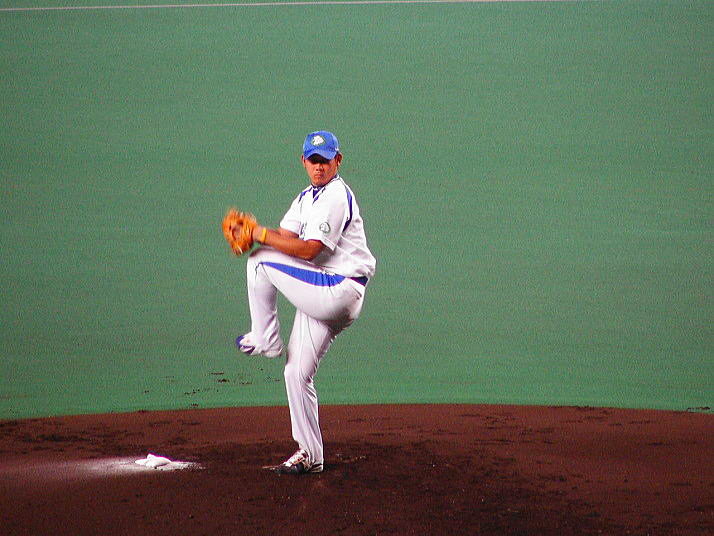
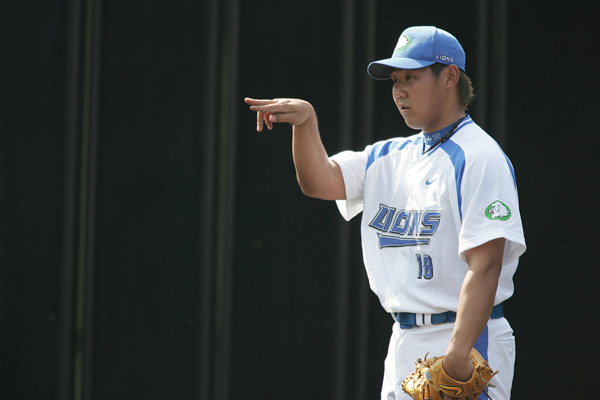
Igawa isn't the beast on the mound that is Matsuzaka. He isn't an imposing force that intimidates hitters, or blows them away with blistering heat. He doesn't have that frightening glare that makes batters swallow hard, a la Clemens, but he has a presence. His stuff isn't electric, and doesn't make you leap out of your seat, like "What the hell was that?!" He throws hard enough(88-91 on the fastball), and has a plus plus change(78-81)that serves him well. Combine those pitches with a plus slider(80-83), and you have a solid player on your hands every 5 days. That's the up and down of Igawa. You can read a very thorough
scouting report on him here.
His career stats are good. He has a 3.15 lifetime ERA, which is made to look worse by his shaky 2004 and 2005 campaigns. He has a career .235 BAA, .297 OBPA, and .288 BABIP over 190 games in 6 full seasons and change. Click the chart below for his 2006 game log, and important ratios.

You can see that his ratios were generally very good in 2006. He posted a 2.97 ERA and a 1.096 WHIP, which are better than average in the Central League. His ERA was good for 7th, and his WHIP was 5th. Igawa was 3rd in innings pitched, and 2nd in wins. 8 complete games was good enough for 2nd overall in the Central, and 3 shutouts was tied at the top with two other outstanding pitchers (Kawakami and Miura). Igawa closed out the season with a flurry of strikeouts to tie Kenshin Kawakami for the league strikeout crown. Looking more closely at his ratios, we find that he posted a .223 BAA with 8.35 K/9 and an outstanding 3.96 K/BB mark. I'm a big fan of the K/BB ratio, as regular readers may know, and I think it's worthwhile to examine what he's done in his career year by year to evaluate his combination of power and control. I did
a piece at Matsuzaka Watch in which I evaluated Matsuzaka against the other top pitcher of the last generation. Igawa is one of the 10 pitchers on that list, and you should stop there to read a bit. Here are the K/BB ratios for Igawa:
2001 1.92
2002 3.89
2003 3.09
2004 4.22
2005 2.42
2006 3.96
Anything close to 4 is outstanding. The thing that separates Matsuzaka from virtually all other Japanese frontline pitchers is his ridiculous combination of control and power. His K/BB ratios have been skyrocketing in the Curt Schilling range for the last 3-4 seasons and topped out at 6.06 in 2006. Igawa has shown flashes of this ability too, although you'll note by his game log that he can lose the plate on occasion. Let's look at his Pitcher Abuse Points, shall we? First what are the stats we need to know:
TOT_NP = The number of pitches a pitcher has thrown in 2006.
MAX_NP = The highest number of pitches he threw in one start.
AVG_NP = The average number of pitches thrown per start.
TOT_PAP = Total Pitcher Abuse Points (NP-100)^3 where NP > 100
MAX_PAP = The single highest PAP total in one start.
AVG_PAP = The average PAP total across the full season's work.
CAT 1 = 1-100 pitch starts
CAT 2 = 101-109
CAT 3 = 110-121
CAT 4 = 122-132
CAT 5 = 133+
Stress = PAP/NP
Baseball Prospectus lists the following Major Leaguers as the leaders for 2006:
1. Livan Hernandez (4266 average, 42 Stress)
2. Carlos Zambrano (4085 average, 37 Stress)
3. Aaron Harang (3636 average, 34 Stress)
4. Jason Schmidt (3353 average, 31 Stress)
5. Dontrelle Willis (3202 average, 30 Stress)
Here is Igawa (click below):

I posted the Top 5 Major Leaguers and their stats, not to throw crazy numbers at you, but rather to show you how out of control Japan is in abusing pitchers. Igawa sports a 18,040 average and a 157 Stress. That's probably about league average. Yikes!!! Hope the Yankees give him a good physical.
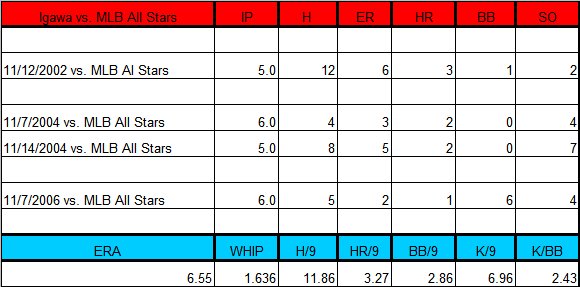
I'll also throw you his MLB All Star Series numbers. It's worthwhile to see how Igawa has fared in a small sample size against Major League hitters.

The answer is......not well. He has been absolutely tattooed against Major Leaguers. Before anyone tries to look on the bright side, and say that it's unfair to evaluate him with a 4 game sample size against the best players in the Majors, Matsuzaka, Uehara, Kawakami, and Iwakuma have all shined in these series. Those are some of his most impressive peers. How he does in a real MLB situation remains to be seen, but these numbers aren't very encouraging.
The last thing I want to attack is an MLB projection, based on
Jim Albright's work. He has been fairly successful with a simple set of calculations. This should be nothing more than an extremely rough sketch of Igawa's upside. He could be infinitely worse, or simply league average.
I did this same process for Matsuzaka some time ago and the numbers look reasonable to me, save the ERA, which was far too low in my opinion. Clay Davenport at BP has done more fine work on Matsuzaka, and perhaps his calculations will arise yet again for Igawa. In the meantime:
29 GS
209 IP
18-5 (.770)
3.13 ERA
194 hits
21 HRs
53 BB
172 Ks
1.182 WHIP
3.25 K/BB
7.41 K/9
I see problems with the ERA in this situation again. The calculations don't seem to pan out when I do this process, although Albright has had some success with it. The WHIP, K/BB, and K/9 resemble a few different pitchers. I'll try to list the upside, mid-range, and lower expectations by choosing 3 lefties based on these numbers.
1. CC Sabathia (3.22 ERA, 1.17 WHIP, 3.91 K/BB, 8.03 K/9, 44 BB, 172 K)
2. Andy Pettitte (4.20 ERA, 1.44 WHIP, 2.54 K/BB, 7.47 K/9, 70 BB, 178 K)
3. Randy Johnson (5.00 ERA, 1.24 WHIP, 2.87 K/BB, 7.55 K/9, 60 BB, 172 K)
That's a good list of players. Remember, that's if Albright's projections hold up. It's important to note that Sabathia had a .247 BAA, Unit had a .250 BAA and Pettitte in the NL sported a .284 BAA. The 2006 ERA+ for the 3 pitcher above are:
Sabathia 139
Pettitte 108
Johnson 88
If the Yankees can manage a 2006 Andy Pettitte out of Kei Igawa, and can do so at a price of around $26 million posting, plus 4 years at $4-5 million a year, you'll be spending about $10-11 million per for Igawa at 27-28 years of age. Pettitte's 2006 salary was $16 million and change at 33-34. It's a gamble. One final word today. Looking at the two flops from the Japanese pitching ranks, Kazuhisa Ishii and Hideki Irabu, I find that Ishii was about a half to a full notch below Igawa in statistical analysis. His career ERA in the Majors was 4.44 and his career ERA+ was 91. Irabu and Igawa pitched together for Hanshin in 2003. Irabu's ERA was a full run higher. Looking at his MLB career he put up a 5.15 ERA and an 88 ERA+. If I were to use those players as a benchmark for Igawa, I'd have to say he'll post about a 4.10 or 4.20 ERA in all likelihood, and perhaps live up to Andy Pettitte's year in 2006. Hmmmmm....It's up to you to decide if that's worth the money. I'll keep you posted on more......
UPDATE: I forgot to mention before I went to sleep last night that I think the ERA for Igawa will be around 4.20, which will change the above mentioned W/L to something akin to his 14-9 over 29 starts with Hanshin. Interesting. If he makes 34 starts, he could win 16 games against 10 losses, or something in that neighborhood. Give or take.

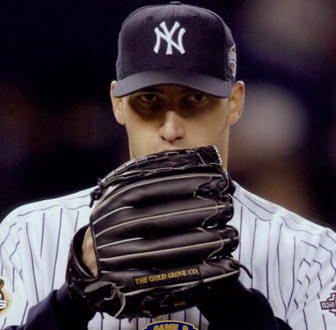 I've had a little time to digest the numbers I projected for Kei Igawa, and I've found something very interesting. My calculations for Matsuzaka were very close to the numbers that Clay Davenport of BR made for the future Red Sox ace, with the exception of the ERA, which came in far too low. The rest was in the ballpark.
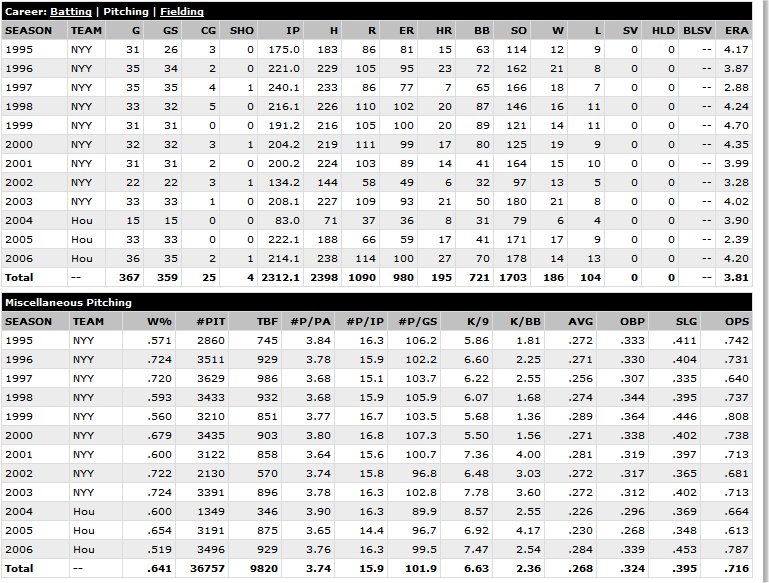 In 1998, 1999, and 2000 Pettitte pitched ERAs of 4.21, 4.70, and 4.35 respectively. He put up 80-90 walks each of those years, against 120-140 strikeouts. I'll list his important ratios below so you can see what he did.
 Note that Pettitte's WHIP is consistently over 1.400 and that his K-rate is between 5.50 and 6.00 during this stretch. His ratios aren't anything remarkable to look at, really, but considering the reverence with which Yankee fans hold Pettitte, and the thought that we might bring him back to the Yankees at the age of 33-34, it's important to note. Is it a stretch to consider these numbers a fair range for Igawa? He's a lefty with numbers that translate along these very lines, if not better, and he is pitching in the same age range from which Pettitte is shown above. People who have been watching Matsuzaka have been comparing him with the finest pitchers in the world. The names Roger Clemens,Roy Halladay, Brandon Webb, Chris Carpenter, Jason Schmidt, Josh Beckett, Pedro Martinez, Tim Hudson and Jake Peavy have been used. Igawa has not been of this caliber in Japan, despite being an ace, but then again neither was Pettitte.